
National treasury
Washington has a slew of coveted players. How many of them will move in the next week?

vivaelbirdos.com photo
Say this much for the Washington Nationals: They do things on their own schedule.
More than a week before Major League Baseball’s trade deadline, the Nationals made the first splash. They sent infielder Curtis Mead to the Boston Red Sox Saturday night in exchange for promising left-handed starting pitcher Connelly Early in what looks like a solid move.
It’s likely not the last move they will make, and it signals that a precocious team ahead of schedule in its rebuild may be making a bid for an unexpected playoff berth this fall. (Don’t forget, the Nats’ World Series run in 2019 started with a wild-card berth.)
To be fair, that ’19 squad had a Hall of Fame pitcher in Max Scherzer and another ace (Stephen Strasburg) who might have been on a path to Cooperstown had injuries not derailed his career. This edition has a couple of lively starting arms (plus Early, who’s currently on the Injured List), but an atrocious bullpen. So simply playing meaningful games in September would be a bonus.
Still, the Nationals are arguably the most interesting team to watch, both on and off the field, in the upcoming week. They have baseball’s best offense, and they could be the most active organization before the deadline.
What their new front office must decide is exactly how far to go. Their options range from conservative to incredibly extreme. Besides looking out for the franchise’s best interests, they need to forecast how much the suddenly frugal Lerner family will agree to spend in the future — and just how patient a long-suffering fan base will be.
Odds are high that the Nationals will listen to offers for first baseman Luis Garcia Jr. and right-hander Foster Griffin, two of the team’s biggest success stories this season.
Entering play Monday, Garcia had 21 home runs, 70 RBIs and a .940 OPS and will be in demand as one of the rare corner infielders with power available at the deadline. Foster (12-2, 2.76 ERA, a 1.03 WHIP) is tied for second in the majors in victories after spending the past three seasons in exile in Japan.
Dealing one or both could further strengthen a talented farm system, but it likely would short-circuit any long-shot playoff hopes for 2026. (Few observers, even inside the clubhouse, thought that would happen anyway.)
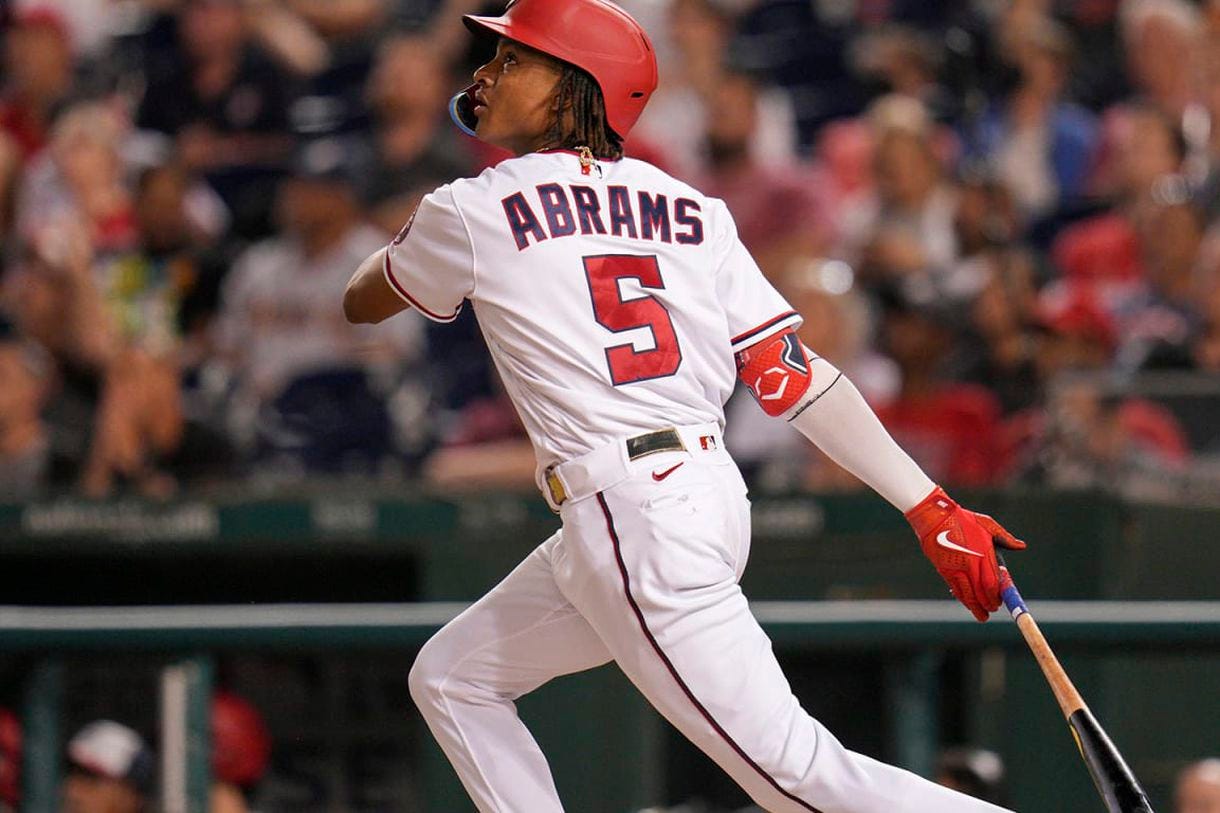
If Paul Toboni wants to really think big — and alienate a large portion of his fan base — he’ll also accept calls from rival general managers regarding his two biggest stars, MVP candidates James Wood and CJ Abrams.
At 23, Wood has 30 homers, 25 doubles, 15 steals, a .953 OPS and has scored 96 runs, a staggering 24 more than any other major leaguer. Abrams, 25, is a below-average fielder but leads the majors with 82 RBIs and already has set a franchise season record for home runs by a shortstop (27) with 56 games remaining.
Few teams have anything remotely resembling that kind of 1-2 offensive punch, and on most franchises, they would be untouchable. But the Nationals aren’t most teams.
First, they have a brand new, young front office that inherited those stars. Second, they have an ownership family that acts as though they’re a small-market team. (This year’s highest-paid National is Garcia at $6.875 million, or about what Juan Soto makes every three weeks from the Mets.)
Wood’s agent is Scott Boras, which means there’s little chance of signing him to a hometown discount before he becomes eligible for free agency after the 2029 season. Abrams also would be eligible to hit the market that winter, but he’s much more likely to be wearing another uniform before then.
Toboni’s calculus has to include his team’s slim playoff chances (especially if he trades Garcia and/or Foster), plus the impending labor stoppage that could wipe out much (if not all) of the 2027 season and the fact that the market will never be greater for Abrams and Wood, who each homered twice on Sunday and are under team control for three more seasons.
They were both part of the haul Mike Rizzo brought to D.C. in exchange for Soto in 2022, and each could fetch several top prospects from a desperate contender with a deep farm system like the Dodgers, Yankees or Rays. Trading either would be tantamount to waving a white flag for this season — and ensuring that attendance plummets.
Whenever MLB’s new collective bargaining agreement is reached, it may well include a salary cap and a floor that will be well above the Nationals’ current $95 million payroll. (By the way, a third of that goes to Strasburg, who last pitched in 2022, for the final year of his contract.)
That could force the Lerners to pay Wood his market rate, which might rival that of Soto and Shohei Otani. But that’s a matter for a future Toboni to worry about. For now, he’ll spend even more time than usual on the phone.
The Nationals have been surprisingly fun to watch on the field this year. For the next week, the front office will be even harder to take your eyes off of.