
Gender equity?
Women's basketball coaches apparently can misbehave just as well as their male counterparts.

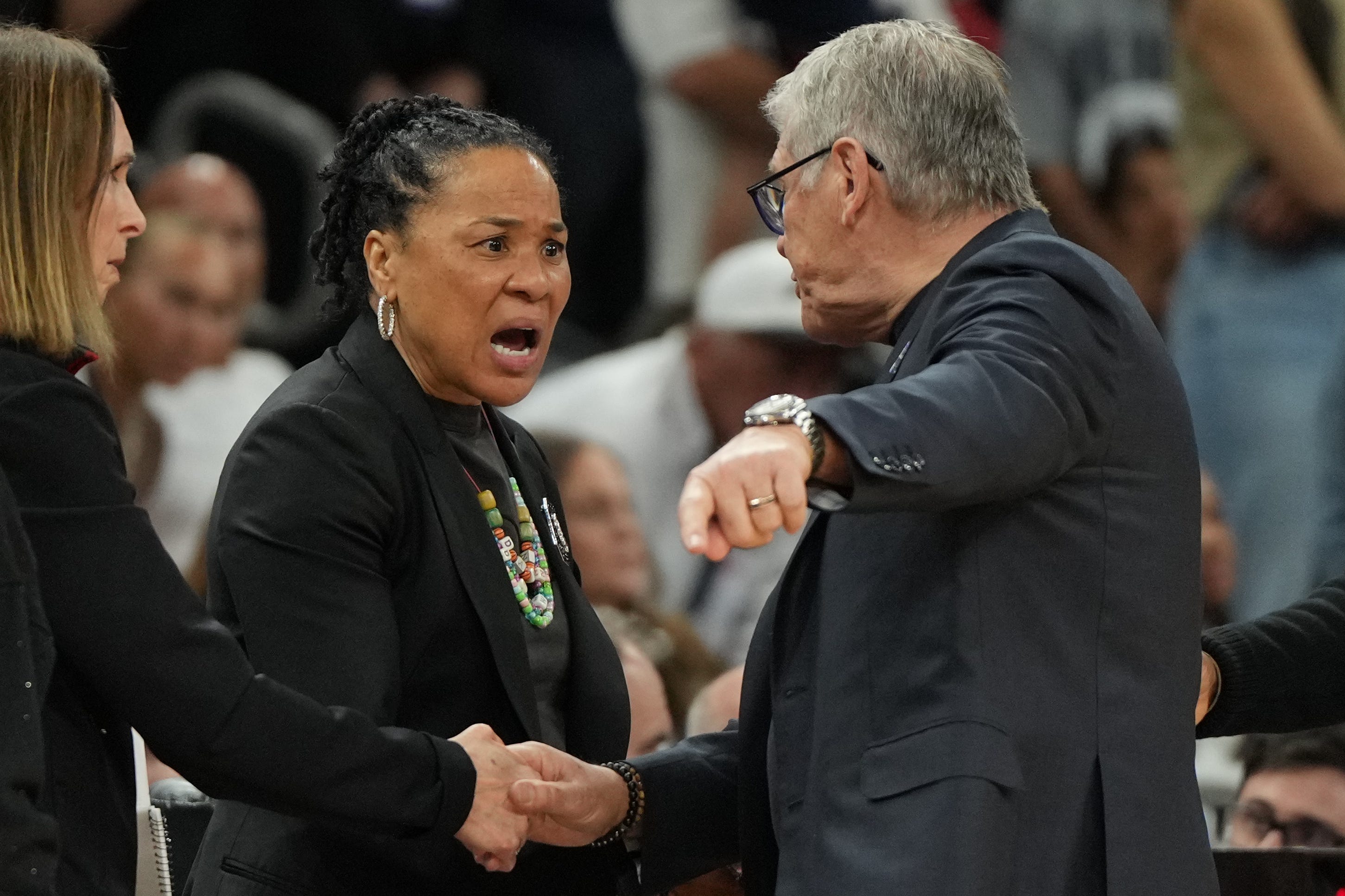
Associated Press photo
Two years ago, thanks largely to stars Caitlin Clark and Angel Reese, NCAA women’s basketball eclipsed the men’s side in popularity.
The tournament games were compelling, the talent exceptional. While the top men’s players were often one-year mercenaries more concerned with improving their brands than their skills, the ladies showed the value of continuity and maturity and gained a new generation of fans.
Again this season, the women’s game has shown it can compare with the men’s — but not always for the right reasons.
All credit to UCLA, which finally gets to hang a women’s national championship banner in Pauley Pavilion to accompany the 11 won by the men’s teams (10 by John Wooden). Sadly, though, that achievement got overshadowed by UConn coach Geno Auriemma’s postgame confrontation with Dawn Staley after his Huskies lost to South Carolina in the semifinals.
Auriemma, the winningest basketball coach in NCAA history (of either gender) claimed to be angry that Staley failed to shake his hand before the game. More likely, he was frustrated that his previously unbeaten team got thoroughly outplayed and whistled for more than twice as many fouls (17) as did the Gamecocks (eight).
Hours later, another surprising development stole the headlines, as Virginia fired coach Amaka Agugua-Hamilton barely a week after its most successful season in a quarter century.
The Cavaliers had become the first women’s team ever to advance from the First Four to the Sweet 16, upsetting second-seeded Iowa in the second round. And with a huge investment from U.Va. grad Alexis Ohanian (co-founder of Reddit and the husband of Serena Williams), they seemed poised for even better things to come.
But reports emerged of what my friend Jerry Ratcliffe, who has covered Virginia athletics for nearly half a century, called “a toxic, nightmarish atmosphere” within the program, according to one source. You can draw your own conclusion about what that means, but nearly every player on the roster intended to transfer, according to the reports; all-ACC guard Kymora Johnson already has placed her name in the portal.
No one has gone on the record, and Virginia moved quickly to hire former Richmond coach Aaron Roussell as Agugua-Hamilton’s replacement. The goal clearly is to avoid a catastrophic collapse following the Cavaliers’ first Sweet 16 appearance since 2000 and perhaps coax Johnson and others into staying around.
Roussell brings a sterling reputation, having built a winning program at Bucknell before leading the Spiders into the NCAA field in each of the past three seasons. But similar things were said of Agugua-Hamilton four years ago when she arrived fresh off success at Missouri State, and look what happened.
The Cavaliers were perennial national contenders under coach Debbie Ryan for more than a decade, especially when Staley was their All-America point guard in the early 1990s. But after several down years, they forced Ryan into an early retirement in 2011, and the program hadn’t been consistently competitive since. In fact, it was downright dreadful (30-63) under the unqualified Tina Thompson from 2018-22.
Even worse, Ryan’s ouster didn’t sit well with Staley, who reportedly rejected overtures to return to her alma mater as coach before Thompson was hired. (Given Staley’s status in Columbia, why would she leave?)
Even though she failed to win a second straight national title (and fourth overall), Staley found herself having to answer a lot of questions about other coaches last weekend. That wasn’t fair to her or her players.
Auriemma — who, incidentally, cut his teeth as a young assistant to Ryan at U.Va. in the 1980s — later posted a lukewarm apology for his postgame meltdown. But it failed to mention Staley by name, and he’s taken a lot of heat in the aftermath.
We haven’t often seen women’s coaches get that confrontational. Fans of a certain age can remember Temple’s legendary John Chaney breaking into a postgame press conference held by a young John Calipari in 1994, offering to fight him and yelling, “I’ll kill you.” Auriemma didn’t go that far, but he did move the needle in a direction that no one wanted to see.
The equipment has been stowed away for a few months, and our attention has begun to turn toward the Masters and baseball. But let’s take a moment to acknowledge that while women’s basketball has always sought equal footing with the men, it’s starting to get there — for better or for worse.