
Crossing a red line
Balogun's World Cup reinstatement reeks of favoritism and corruption,

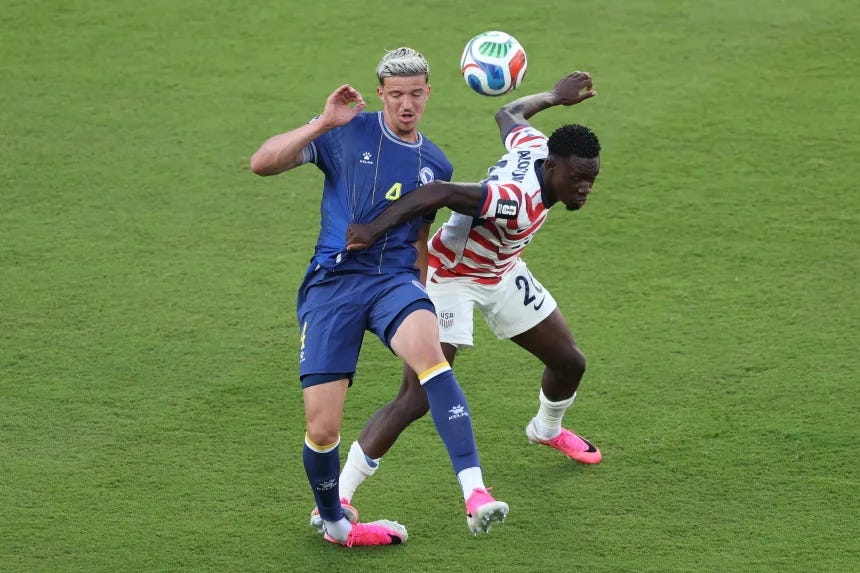
Getty Images photo
Imagine this not-so-remote scenario:
After 120 minutes of hard-fought soccer Monday night, neither the United States nor Belgium can assert superiority. Their FIFA World Cup Round of 16 knockout match comes down to penalty kicks and reaches the fifth round.
Up steps Folarin Balogun, who (only partly of his own volition) has become the tournament’s most polarizing player. He needs to convert to keep U.S. hopes alive.
What are you hoping will happen?
As a proud American, I will admit that it wouldn’t break my heart if he missed or was stymied by the Belgian goalie. Balogun’s mere presence in the match — and the unseemliness that surrounds it — doesn’t sit well with me.
I’m guessing I’m not alone.
Let me be clear: I’ve covered sports for four decades, and soccer is among those in which I have the least expertise. I’m not all that familiar with strategic moves like shifting a center back up to midfield or an overlapping run by a forward. (I’m not even 100 percent sure if either of those is really a thing.)
I can usually spot a foul (though not always, after watching this year’s World Cup) but I struggle to know which ones deserve a red card. That was true of Balogun’s tackle of Bosnia and Herzegovina’s Tarik Muharemovic in their most recent match last Wednesday.
It was clearly a violation, but did it merit a red card and disqualification not only from that match, but the next one as well? Even the referee didn’t immediately think so, but after a replay, that was the ruling.
And even though this is a litigious nation, it should have ended there, despite the protestations of millions of Americans — many of whom, like me, rarely tune in during the 3 11/12 years between World Cups. Yes, there should be an appeal process, but the rules seem to be pretty clear.
Or are they? On Sunday, FIFA announced that Balogun’s red card had been rescinded under Article 27 of its player conduct code, and that he was eligible to face Belgium Monday night in Seattle. That means the U.S. gets back its best goal-scoring threat for arguably the biggest game in the team’s history.
How convenient.
Then came reports that Donald Trump personally asked FIFA president Gianni Infantino and asked him to review Balogun’s red card. You know, the same Infantino who invented a FIFA Peace Prize and awarded the inaugural one to Trump for who knows why.
Asking which of those two men is more corrupt is like asking which Sharknado movie has the dumbest plot. Put them on the same phone line, and who knows what shenanigans might ensue.
What was promised, or threatened, we may never know. What we do know is this: Balogun will play. He’ll likely have a significant impact on a game in which he shouldn’t even be allowed to suit up.
And whether the Americans win or lose, it stinks.
Soccer bills itself as “The Beautiful Game.” And this World Cup has shown us why: exceptional talent, intriguing games and loveable overachievers. (Just wait to see how much more tourism Cape Verde gets next year.)
With or without Balogun in uniform Monday night, the U.S. still had a chance to join the party. If their compatriots can crash the quarterfinals for just the third time ever because FIFA showed favoritism, many Americans probably won’t care how it happened.
But as one prominent American likes to say, it’ll feel like the system was rigged.